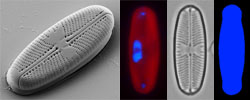
David Mann and Rosa Trobajo
Royal Botanic Garden Edinburgh, UK, and Institute for Agrifood Research and Technology, Catalonia, Spain
October 2026
Actinocyclus: a bloom-forming benthic centric diatom
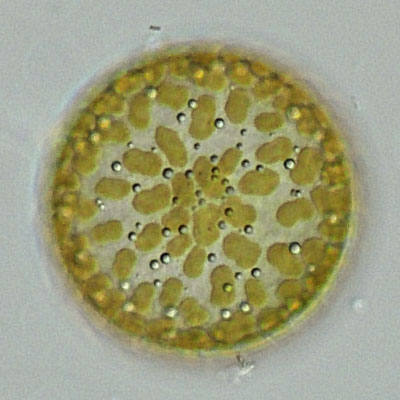
Image: Living Actinocyclus cell from Llavaneres, August 2025
The ECOS-COM project followed seasonal changes in the marine benthic diatom flora at three sites (Llavaneres in Catalonia, NW Spain, and two locations in El Hierro, the Canary Islands) in 2024 and 2025. The aim was to see whether the diatom flora shows any changes in response to, or correlated with, the annual growth cycle of the toxic dinoflagellate Ostreopsis, which blooms in July and August at the Llavaneres site, causing problems for local residents. The study combined light microscopical surveys and cell counts with DNA metabarcoding using a 263-bp rbcL marker.
Results showed that several diatom taxa show marked changes in abundance that correlate with the different growth phases of Ostreopsis. For example, at Llavaneres, Pteroncola largely disappears during the Ostreopsis bloom, whereas the large centric diatom Actinocyclus appears just as Ostreopsis reaches its peak and then increases rapidly, replacing Ostreopsis as the dominant microalga in the periphyton associated with benthic red and brown macroalgae.
Light microscope observations led to a preliminary identification of the Llavaneres Actinocyclus as A. subtilis, by reference to descriptions in classic texts such as Hustedt (1930). However, metabarcoding data indicated that the Actinocyclus at Llavaneres did not correspond to any species with a reference rbcL sequence in GenBank, not even an isolate identified as A. subtilis (MG755799). Subsequently, several strains of the Actinocyclus were isolated by Aitor Laza-Martinez and Adrian Kryk and a reference rbcL sequence was obtained by Sanger sequencing, confirming a wide separation between the Llavaneres "Actinocyclus subtilis" and the MG755799 strain isolated and sequenced by Yu et al. (2018), though both belong to the same Actinocyclus clade. The question that arises, therefore, is whether one or other or both or neither of these two "subtilis" strains truly represents the species.
We therefore surveyed different preparations said to contain A. subtilis, including type material and samples collected during the period in the 1850s and 1860s when the identity and limits of the species were being established. We also examined type material of A. tenuissimus, which is sometimes combined with A. subtilis but was originally separated from it on the basis of its finer and more delicate structure. Here we provide some results of our study, to complement the images and information published elsewhere).
References:
Hustedt, F. (1930). Die Kieselalgen Deutschlands, Österreichs und der Schweiz mit Berücksichtigung der übrigen Länder Europas sowie der angrenzenden Meeresgebiete. In Dr. L. Rabenhorst's Kryptogamen-Flora von Deutschland, Österreich und der Schweiz, vol. 7 (part 1). Akademische Verlagsgesellschaft, Leipzig.
Yu, M., Ashworth, M.P., Hajrah, N.H., Khiyami, M.A., Sabir, M.J., Alhebshi, A.M., Al-Malki, A.L., Sabir, J.S., Theriot, E.C. & Jansen, R.K. (2018). Evolution of the plastid genomes in diatoms. Advances in Botanical Research 85: 129-155.
 This site is hosted
by
the Royal Botanic
Garden Edinburgh.